Understanding Higher Dimensions as a Layperson
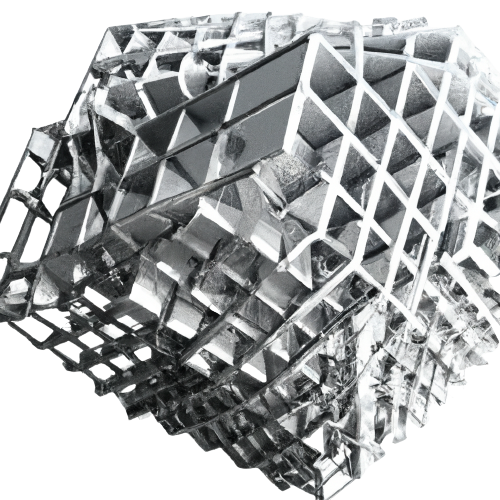
You might have come across terms like ‘fourth dimension’ or higher dimensions in movies, science fiction books, or through people talking about scientific theories. So what exactly are higher dimensions? We are all familiar with the three spatial dimensions (3D): length, breadth, and height, which are used for defining the shape and size of our physical world. Everything in the physical world around us including, tools, people, buildings, structures, and other objects, can be measured using three spatial dimensions.
The 4th dimension
In physics and mathematics, the concept of dimensions beyond 3D is very prominent. Our universe is said to exist in a four-dimensional continuum referred to as spacetime. Spacetime is comprised of three dimensions of space and one dimension of time stitched together. It might be hard to visualize the fourth dimension (i.e. time) because we are used to visualizing dimensions only in terms of space. But think about it this way, when you are climbing up helical or spiral stairs, you are moving forward, sideways, and upwards in the space simultaneously. Additionally, time is always passing as you climb up the stairs, so you are also moving forward in time. Hence, we move through three dimensions of space and one dimension of time.
We may not be able to visualize the fourth dimension of time as well as we could visualize the three dimensions of space because we evolved to only navigate through 3D space and not through the 4th dimension of time. You might be confused because we just established that we also move forward in time. But that is it, so far we can only navigate through the forward flow of time and not in other directions of time, unlike we do it with three spatial dimensions.
Would it be possible to move in a different direction in time as well? Theoretically, it might be possible. Think about moving in the spatial dimension, we can only navigate through 3D space in a limited manner naturally. But we have pioneered tools to help us better navigate through 3D space like stairs, ropes, cars, helicopters, spacecraft, etc. So in the distant future, we might also be able to pioneer tools that could help us navigate time in all its directions.
Science fiction has also taken liberties in the use of the word ‘dimension’ as a fancy alternative term for parallel or alternate universes or other imagined planes of existence. For example, the terms used in science fiction like alternate dimension and pocket dimension don’t mean actual dimensions but alternative universes. So be wary not to confuse higher dimensions in scientific theories with higher dimensions in science fiction. However, we will only be discussing the scientific concept of higher dimensions in this article.
Dimensions beyond the four dimensions
If four dimensions were overwhelming, wait until you find out about string theory. String theory requires additional dimensions to properly describe real physical phenomena. In superstring theory, spacetime is 10-dimensional, while in M-theory it is 11-dimensional. In comparison, spacetime in Bosonic string theory is astounding 26-dimensional. However, these additional dimensions cannot be observed in experiments or in the physical world.
Why does string theory predict so many dimensions? The main goal of string theory is to combine general relativity (physics of large or cosmological objects) and quantum mechanics (physics of subatomic or microscopic objects), which currently do not get along with each other very well, into the theory of everything. To put it simply, it is extremely difficult to define a model this complex with just a few dimensions. Conversely, complex models can be more accurately defined with more dimensions. Therefore, it is predicted that there are at least 10 dimensions in our universe.
Analogies to help understand higher dimensions
Let’s look at a simple analogy to better understand this. Say an engineer has designed a new mechanical tool. If she uses only textual format to present her design then it is going to be extremely difficult to convey the actual design and mechanism of the tool to other people. However, if she is also allowed a single diagram of the tool then the design would be more easier to conceive compared to text alone. Now, let her add multiple drawings of the tool showing different angles, which will make the design even easier to comprehend. Let’s take it one more step forward and let her create a digital 3D model of the tool. With the digital 3D model people can look at the tool from different angles, view the exploded view to study individual parts, and watch an animation to better understand its working mechanism. Hence, adding more levels of access (dimensions) can help describe a model more accurately.
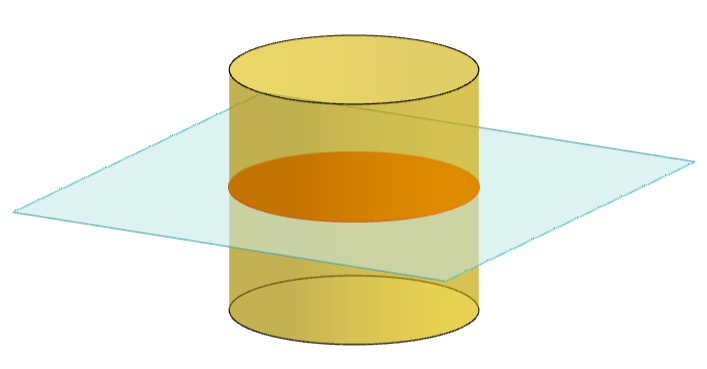
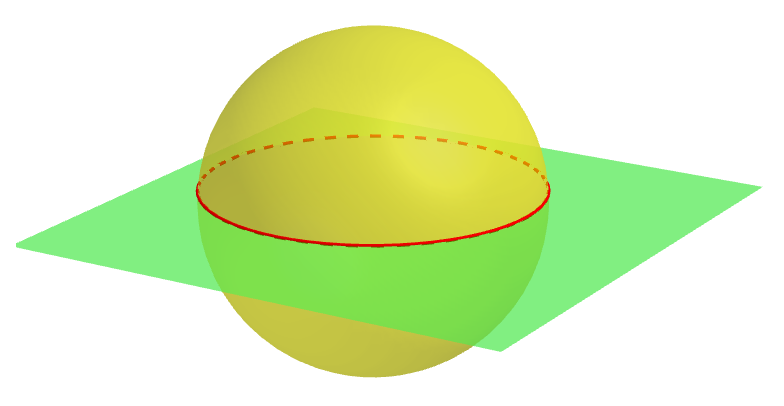
Let’s also take a geometrical approach to understand this better. If you take a cylindrical block and view it in 2D along the horizontal cross-section, then it will look like a circle. Now take a sphere and view it in 2D along the cross-section and it will also look like a circle. So just looking at these cross-sectional images which are both circles, you wouldn’t be able to tell if it’s a cylinder or a sphere. But if you have multiple images of the object from different angles or even better, a 3D view of the object then, there won’t be any ambiguity.
Visualizing higher dimensions using lower dimensions
I don’t know, but they constructed this three-dimensional space inside their five-dimensional reality to allow you to understand it …
~ TARS, Interstellar (2014)
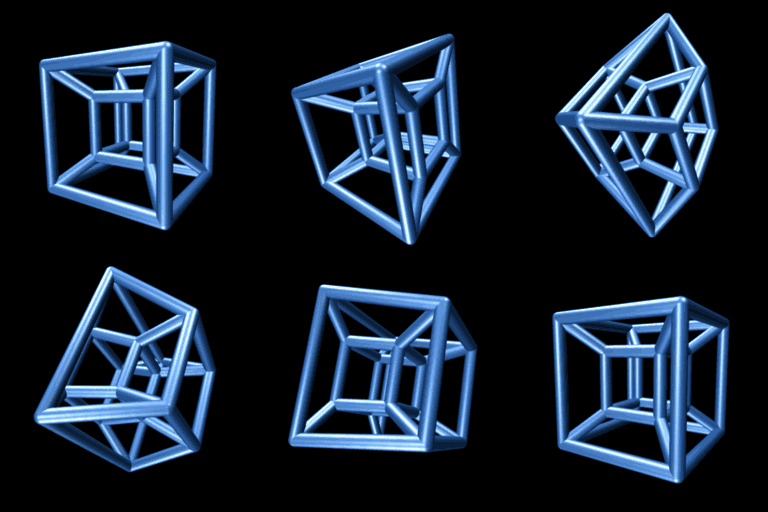
We may not be able to visualize dimensions beyond 3D but we can still imagine higher dimensions by translating it to 3D visualization and adding analogical concepts. A tesseract (also known as hypercube) is a 4D cube that can be visualized using 3D illustrations. However, it could still be a little challenging to wrap our heads around it. The 2014 sci-fi movie Interstellar portrayed the concept of higher dimensions being presented as a 3D structure in a very interesting way. In the movie, the 3D structure was created by supposed future humans as a translation of their 5D reality to make it possible for humans to interact with higher dimensions.
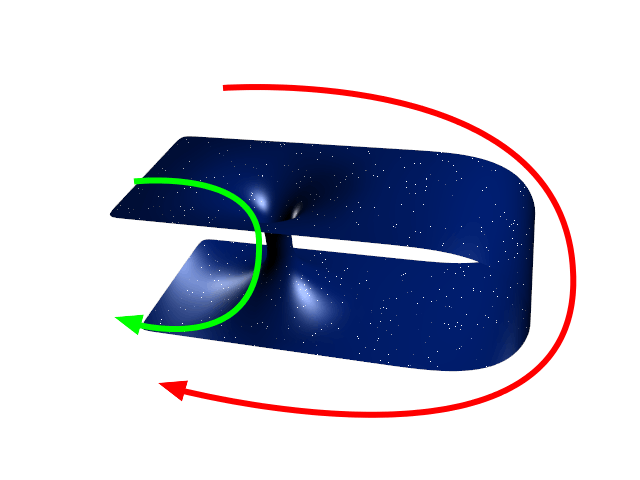
A wormhole (also known as a portal), is a theoretical concept of folding two points in spacetime together to create a shortcut that cuts travel time between these two points astronomically. Basically, it is a hole in spacetime through which you can pass to get into another part of the universe. A wormhole is often portrayed as a circular hole (2D) or a tunnel in science fiction and even scientific papers to make it easier for us to understand the concept of folding space. But in actuality, it would be a spherical hole (3D) or even a hyperspherical hole (4D). The movie Interstellar also does a great job of portraying a wormhole as an actual spherical hole in space.
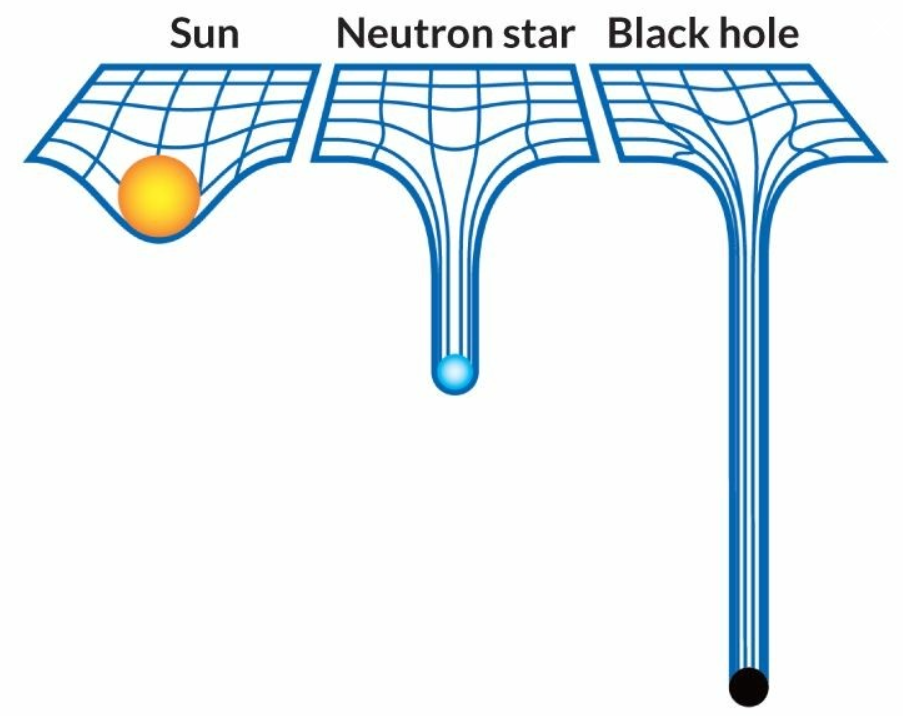
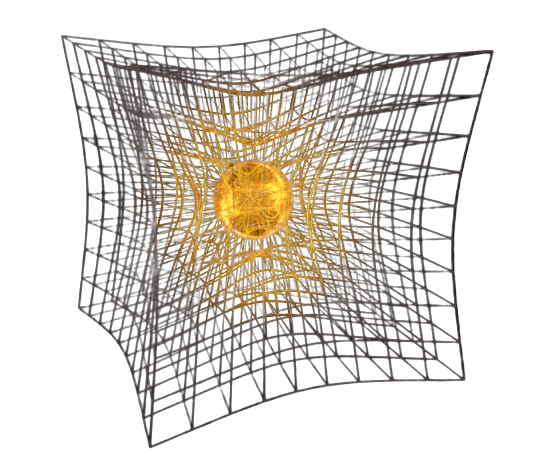
Likewise, a gravity well is often portrayed as a pit or depression in fabric caused by massive objects. But in actuality, gravity wells are bends created in 4D spacetime due to the gravity of celestial objects like planets, stars, and black holes, which is nearly impossible to visualize as is.
Why can’t we see higher dimensions?
So where are the other dimensions? Why can’t we see them? All other dimensions are also interwoven to one another along with the 4 dimensions we are more familiar with. We cannot see higher dimensions, probably because the environment we grew up in doesn’t require us to develop the neural structure required to process and interpret the sensation of higher-dimensional attributes. Hence, we lack the intuitive ability to visualize and comprehend higher dimensions. Hypothetically, if we grew up in an alien or otherworldly environment we might be able to develop the mental capacity to see and comprehend more dimensions.
It is important to note that the concept of higher dimensions is primarily theoretical and currently, there’s no direct experimental evidence for their existence. However, this doesn’t mean that higher dimensions don’t exist. It just means that we haven’t yet been able to detect them experimentally or to see any conclusive effect of these higher dimensions in the physical world. Major theories like Superstring theory, M-theory, and Kaluza-Klein theory, which suggest the existence of higher dimensions are still incomplete and haven’t yet been proven experimentally. However, they have been very influential and have generated much discussion, debate, and research in the fields of physics and mathematics.
Comments
Post a Comment